
Showing posts with label Diagrams. Show all posts
Showing posts with label Diagrams. Show all posts
Origami Flower : Lily

Lilium (Lily) is a genus of herbaceous flowering plants growing from bulbs. Most species are native to the temperate northern hemisphere. They comprise a genus of about 110 species in the lily family (Liliaceae).They are important as large showy flowering garden plants. Additionally, they are important culturally and in literature in much of the world. Some species are sometimes grown or harvested for the edible bulbs.
The species in this genus are the true lilies. Many other plants exist with "lily" in the common English name, some of which are quite unrelated to the true lilies.
Category : Intermediate Origami


Origami Pyramid

Origami Pyramid
A pyramid (from Greek "πυραμίς" – pyramis) is a structure where the outer surfaces are triangular and converge at a point. The base of a pyramid can be trilateral, quadrilateral, or any polygon shape, meaning that a pyramid has at least three triangular surfaces (at least four faces including the base). The square pyramid, with square base and four triangular outer surfaces, is a common version.
If you are new to origami this is an excellent project for you. It is very easy to make and it has a wonderful three dimensional shape to it. All you need is a square of paper and printer paper works really well for this fold. Just cut or tear the paper so it is square in shape. This is an easy fold to remember and after you do a few of them you will have it memorized so you can make one at any time.
Category : Intermediate Origami

A pyramid is proportioned with a square base and four equal sides in the shape of triangles, that have 60 degree angles. See the creased paper diagram, there is a square shape at the bottom, with a larger hexagon shape above the square. The line that divides that two shapes is from by the fold in step 5
Origami Shuriken (Ninja Star)

A shuriken (Japanese 手裏剣; literally: "sword hidden in the hand") is a traditional Japanese concealed weapon that was generally used for throwing, and sometimes stabbing or slashing. They are sharpened hand-held blades made from a variety of everyday items such as needles, nails, and knives, as well as coins, washers, and other flat plates of metal.
Shuriken are commonly known in the West as "throwing stars" or "ninja stars", though they took many different shapes and designs during the time they were used. The major varieties of shuriken are the bō shuriken (棒手裏剣, stick shuriken) and the hira shuriken (平手裏剣, flat shuriken) or shaken (車剣, also read as kurumaken, wheel shuriken).

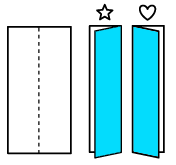


Origami Paper Cup
 Early in the 20th century, it was common to have shared glasses or dippers at water sources such as school faucets or water barrels in trains. This shared use caused public health concerns. One notable investigation into their use was the study by Alvin Davison, biology professor at Lafayette College, published with the sensational title "Death in School Drinking Cups" in Technical World Magazine in August 1908, based on research carried out in Easton, Pennsylvania's public schools. The article was reprinted and distributed by the Massachusetts State Board of Health in November 1909.


Origami Paper Cup Ready to Use!!!
Origami Cat

Origami Cat

Origami Cat

Origami Cat

Origami Cat

Origami Cat
The cat (Felis catus), also known as the domestic cat or housecat to distinguish it from other felines and felids, is a small furry domesticated carnivorous mammal that is valued by humans for its companionship and for its ability to hunt vermin and household pests. Cats have been associated with humans for at least 9,500 years, and are currently the most popular pet in the world. Owing to their close association with humans, cats are now found almost everywhere on earth.
Category : Advanced (Complex Origami)

Click on Image for Large View
| NEXT |
Origami Envelope

An envelope is a common packaging item, usually made of flat material such as paper or cardboard. It is designed to contain a flat object, such as a letter or card.
When the folding sequence is such that the last flap to be closed is on a short side it is referred to in commercial envelope manufacture as a '"pocket"' - a format frequently employed in the packaging of small quantities of seeds. Although in principle the flaps can be held in place by securing the topmost flap at a single point (for example with a wax seal), generally they are pasted or gummed together at the overlaps. They are most commonly used for enclosing and sending mail (letters) through a prepaid-postage postal system.


Subscribe to:
Posts
(Atom)